
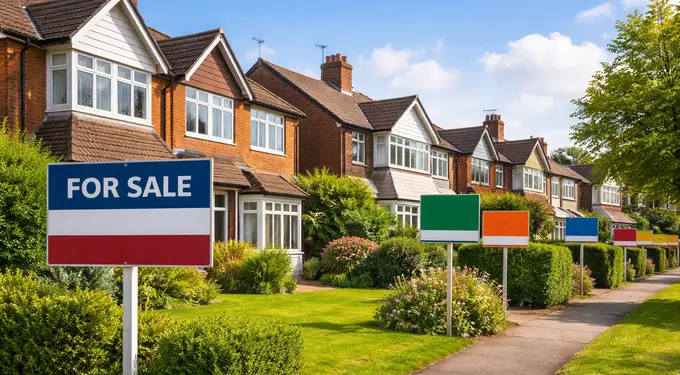
British house prices unexpectedly increased in April, even as consumer confidence weakened amid rising geopolitical tensions, according to a report by Nationwide Building Society .
House prices rose 0.4% month-on-month in April, reversing expectations of a decline.
On an annual basis, prices were 3.0% higher.
This came despite forecasts from economists polled by Reuters, who had expected a 0.3% monthly drop and annual growth of 2.2%.
Rising mortgage rates weigh on demand
Mortgage rates in Britain have increased since the start of the Iran conflict at the end of February.
This has added pressure on prospective homebuyers.
Consumer sentiment has also deteriorated, falling to its lowest level since 2023.
Surveyors reported weaker buyer demand in March, signalling a slowdown in housing market activity.
Separate data released earlier this week reinforced the negative outlook.
Broader consumer morale declined sharply last month, reaching its lowest point since mid-2023.
Consumer confidence hits multi-year lows
Data from S&P Global showed its consumer sentiment index fell to 42.3 from 44.1, marking a 33-month low.
Meanwhile, a quarterly survey by Deloitte indicated that confidence dropped to its lowest level since the third quarter of 2023.
Both surveys highlighted growing concerns among households about their financial situation and job security.
This suggests increasing pressure on consumers amid broader economic uncertainty.
Inflation and energy concerns intensify
Inflation remains a key concern for the UK economy.
Britain’s inflation rate is already the highest among the Group of Seven advanced economies and is expected to rise further.
Investors believe the country is particularly vulnerable to rising energy prices.
This follows US-Israeli attacks on Iran that began at the end of February.
The geopolitical tensions have added to existing cost-of-living pressures.
This has increased uncertainty for households already dealing with elevated expenses.
Political uncertainty weighs on sterling
Sterling is struggling to build on recent gains as a mix of political uncertainty, inflation concerns and upcoming local elections weighs on sentiment.
Traders believe the coming week could be decisive for both the currency and Prime Minister Keir Starmer’s political future.
Sentiment has been further dented by the fallout from the Peter Mandelson affair.
Mandelson was dismissed as British ambassador to the United States in September 2025 after emails showed he had maintained contact with Jeffrey Epstein following a 2008 conviction.
On 23 February 2026, he was arrested on suspicion of misconduct in public office, days after Andrew Mountbatten-Windsor was arrested on similar allegations.
Mandelson was later released on bail and has not been charged.
Geopolitical risks add to uncertainty
Concerns escalated further earlier this week as uncertainty surrounding a ceasefire between the United States and Iran intensified.
The US said it had seized an Iranian cargo ship attempting to bypass its blockade.
In response, Iran vowed retaliation, raising fears of further escalation.
These developments have contributed to market volatility and heightened economic uncertainty.
Despite these pressures, the housing market has shown resilience in April.
However, the broader outlook remains uncertain, with rising borrowing costs, inflation concerns, and geopolitical risks continuing to weigh on consumer confidence and housing demand.
The post UK house prices defy forecasts, climb amid economic concerns appeared first on Invezz
