
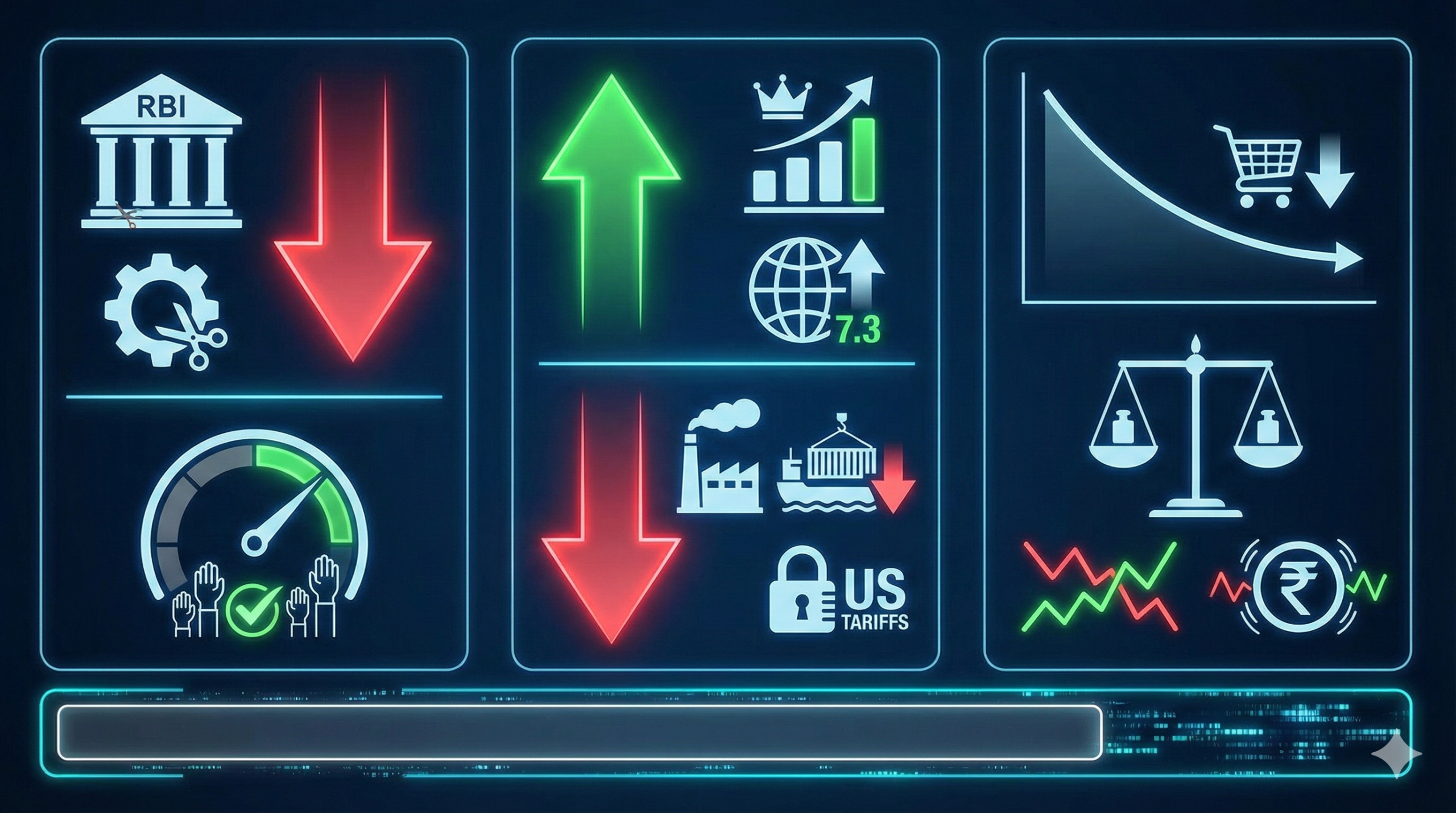
India’s central bank lowered its benchmark policy rate by 25 basis points to 5.25% on Wednesday, matching expectations from economists.
The Reserve Bank of India’s monetary policy committee delivered the reduction unanimously, citing “weakness in some key economic indicators,” according to RBI governor Sanjay Malhotra.
The decision comes as headline inflation remains subdued and is expected to be revised lower in the first quarter of 2025.
Malhotra said headline inflation had eased significantly.
Inflation forecasts revised downward
The RBI projected Consumer Price Index inflation at 2% for FY2025-26, reflecting a substantial downward revision.
For the first quarter of FY2026-27, inflation is projected at 3.9%, compared with the previous estimate of 4.5%.
Malhotra noted that rising precious metal prices could add marginally to headline CPI but said risks to the forecast remain evenly balanced.
Malhotra had warned at the previous policy meeting in October that, despite significantly moderated inflation in the first quarter, growth could slow in the latter half of the financial year due to global trade uncertainties.
Those risks remain, even as the RBI adjusts its inflation outlook lower.
Strong GDP supports rate cut decision
India’s economy expanded 8.2% in the July–September quarter, marking a six-quarter high and outpacing consensus expectations.
Real GDP rose to ₹48.63 lakh crore compared with ₹44.94 lakh crore in the same period last year.
Growth has now averaged 8.0% in the first half of FY2025-26.
Against that backdrop, the RBI sharply raised its GDP forecast for the full financial year to 7.3%, up from 6.8%.
For the current quarter, the central bank now expects growth of 6.7%, compared with its earlier projection of 6.4%.
Malhotra said the “growth-inflation balance continues to provide policy space,” allowing the committee to proceed with easing despite broader economic caution.
Industrial weakness and falling exports raise concerns
Even with strong headline GDP numbers, several indicators point to an emerging slowdown.
Industrial activity in October fell to a 14-month low, while HSBC’s manufacturing PMI slipped to a nine-month low in November.
Export performance has also weakened. Shipments to the US — one of India’s largest markets — declined 8.5% year on year in October to $6.3 billion, marking the second consecutive monthly decline.
Total outbound shipments fell 11.8% to $34.38 billion.
The decline follows Washington’s move to impose a 50% tariff on Indian goods in August.
In response, New Delhi reduced goods and services tax rates in September to support domestic demand ahead of the festive season.
GST collections improved sharply in October to ₹1.95 trillion, up 4.6% from a year earlier, but momentum faded in November, when gross collections totalled ₹1.7 trillion — a modest 0.7% increase.
The Indian rupee has weakened in recent days, slipping beyond the psychologically important 90-per-dollar level on Wednesday before recovering some ground.
The currency volatility adds another layer of uncertainty as policymakers balance the need to support growth without jeopardising stability.
The post India’s Central Bank lowers rates, citing weak pockets in economic data appeared first on Invezz
